
Treaty Descent Record
Hunnic Matinecock Tribal Nation
Official Record of Ancestral, Sachemic, Kinship, and Treaty-Connected Continuity
The Treaty Descent Record is maintained by the Hunnic Matinecock Tribal Nation as an official account of the ancestral relationships, Indigenous kinship systems, sachemic lines, historic compacts, and treaty-connected peoples represented within the Nation’s continuity.
The Nation understands descent and succession first through Indigenous law.
Within Indigenous legal and cultural systems, continuity may be transmitted through:
- Direct lineal descent
- Maternal and paternal inheritance
- Collateral and extended-family kinship
- Sachemic succession
- Marriage alliance
- Adoption and incorporation
- Reciprocal protection
- Confederated relationship
- Compact and treaty
- Continuing responsibility to people and homeland
Colonial, state, federal, genealogical, and archival records are used as corroborating evidence. They document relationships that existed within Indigenous law; they are not treated as the original source of Indigenous identity, kinship, or authority.
The Nation’s standing arises through its own ancestry, inherited relationships, customary law, governance, institutions, and national service.
The treaty histories, rolls, records, and continuing governments of related Indigenous peoples provide additional historical and evidentiary context. They do not replace the Nation’s own foundation or confer authority over the citizenship, lands, government, or internal affairs of another Indigenous nation.
I. Foundational Long Island Continuity
Sachem Catoneras
Sachem Catoneras is a foundational maternal ancestor of the Hunnic Matinecock Tribal Nation.
The surviving historical record expressly identifies her as an “Indian native Sachem.”
Records associated with approximately 1685, 1705, and 1713 further establish that:
- Catoneras possessed inherited Indigenous interests;
- those interests were associated with Crab Meadow;
- her son, Jan Cornelissen, derived his claim through his mother and her Indigenous relations;
- the inheritance did not originate through a colonial grant; and
- Catoneras and her descendants remained connected to the Indigenous landholding and sachemic network of western Long Island.
Through her union with Cornelius Jansen Van Texel, also recorded as Van Tassel, Catoneras carried her maternal ancestry, kinship, inheritance, and family responsibility into succeeding generations.
The Nation recognizes this continuing relationship as the:
Catoneras–Van Texel Kinship Compact
The Catoneras–Van Texel Kinship Compact reflects continuity through:
- Indigenous marriage and family law
- Maternal inheritance
- Intercultural alliance
- Land relationship
- Descendant succession
- Shared family responsibility
- Continuing kinship
The surviving colonial record corroborates this relationship.
It did not create it.
Catoneras therefore stands within the Nation’s record not merely as a distant ancestor, but as a documented female sachem whose inherited interests and descendant continuity form an essential part of the Nation’s living foundation.
Sachem Catoneras — Hereditary Authority and Unbroken Ancestral Continuity
Sachem Catoneras stands among the foundational sovereign ancestors of the Hunnic Matinecock Tribal Nation. Her recorded status as an Indigenous sachem, her inherited territorial interests, and the documented recognition of her descendants’ inheritance provide enduring evidence of Indigenous authority preceding and continuing through the colonial period.
The historical petitions of approximately 1685, 1705, and 1713 establish a recognized line of inheritance through Catoneras, her son Jan Cornelissen Van Texel, and succeeding generations.
The Hunnic Matinecock Tribal Nation maintains that hereditary responsibilities and ancestral standing are understood and transmitted in accordance with Indigenous customary law, including maternal and paternal descent, kinship, recognized succession, and the obligations of ancestral governance.
Within the Nation’s hereditary understanding, Catoneras’s ancestral standing was not extinguished by intermarriage, Christian baptism, the adoption of European surnames, or the subsequent reclassification of her descendants under colonial administration.
Through the Van Texel, Lent, and succeeding family generations, including the documented ancestral line maintained by the Nation’s Sovereign Head, her bloodline remains part of the Nation’s living hereditary foundation.
The Nation recognizes this continuity under its Indigenous laws and traditions. Colonial records provide external corroboration of her sachemic identity and hereditary land interests; they are not the originating source of her authority.
Her ancestry did not disappear. Her descendants did not cease to exist. Her inheritance remains an essential foundation of the Nation’s living identity and governmental tradition.
Tackapousha and the Western Long Island Sachemic Network
The historical record places Catoneras and her descendants within the broader Indigenous governmental and landholding network associated with Tackapousha, principal sachem of the Massapequa.
Tackapousha exercised authority through:
- Sachemic leadership
- Kinship
- Diplomacy
- Land stewardship
- Territorial responsibility
- Intercommunity alliance
- Negotiated relations
- Protection of his people
Opsam, identified in the historical record as Tackapousha’s son, was among the Indigenous owners associated with the Crab Meadow transaction.
Tackapousha personally witnessed the deed.
Their participation places Catoneras, Jan Cornelissen, and the inherited Crab Meadow interests within a documented Indigenous network of landholding, kinship, sachemship, and governance.
The Nation therefore understands Catoneras within the wider political order of western Long Island rather than as an isolated individual asserting a private colonial claim.
The Matinecock–Massapeague Sachemic Kinship and Marriage Network
The ancestral and governmental history of western Long Island was shaped by interconnected Indigenous families whose relationships extended across the Matinecock, Massapeague, Montaukett, and neighboring communities.
Their authority and responsibilities operated through family descent, recognized sachemic leadership, marriage alliances, territorial stewardship, diplomacy, and obligations to their respective peoples.
Sachem Asharoken was a principal Matinecock leader whose recorded territorial interests encompassed lands associated with Huntington and Crab Meadow. His nephew and successor, Sachem Suscaneman, inherited leadership responsibilities associated with Asharoken’s lands.
Historical research documents significant marriages connecting their families with that of Sachem Tackapousha, the principal Massapeague sachem.
Suscaneman married a sister of Tackapousha. In a reciprocal marriage alliance, Tackapousha’s brother, Chopeyconnaws, married a sister of Suscaneman.
These marriages joined two important Indigenous leadership families, reinforcing relationships across their respective communities.
The wider political and familial network also included Sachem Nasseconseke, associated with the Nissequogue River region, and Grand Sachem Wyandanch of the Montaukett. Historical testimony from 1666 described kinship relationships among Wyandanch, Asharoken, Nasseconseke, and Tackapousha.
Sachem Catoneras and her descendants appear within this interconnected order.
The 1685 Crab Meadow deed places her son, Jan Cornelissen Van Texel, alongside Opsam, the documented son of Tackapousha, and Wenox as joint landholders. Tackapousha witnessed the transaction, while Lowee, the son of Wenox, appeared among the witnesses.
This record provides substantial evidence of shared Indigenous territorial and family interests.
The specific biological relationship between Catoneras and Tackapousha remains a subject of historical reconstruction. A possible sibling relationship has been proposed by scholars, while other inherited traditions place Catoneras within different branches of Long Island’s sachemic families.
These interpretive questions do not alter the documented maternal descent from Catoneras to Jan Cornelissen and subsequent generations.
The Hunnic Matinecock Tribal Nation preserves this network as part of the ancestral political world within which its documented maternal line existed.
Its history is one of connected Indigenous peoples, recognized kinship, female and male sachemic leadership, inherited responsibility, and continuity across generations.
Mongotucksee and Wyandanch
Sachem Mongotucksee, remembered as “Long Knife,” was a prominent Montaukett leader during the period preceding and surrounding sustained colonial contact.
His son, Grand Sachem Wyandanch, became one of the principal Indigenous diplomatic and political leaders of seventeenth-century Long Island.
Montaukett and Van Texel–Van Tassel lineage traditions place Catoneras within the close family and sachemic circle of Wyandanch.
Where surviving colonial records do not conclusively establish biological paternity, the Nation preserves the distinction between:
- documented biological descent;
- inherited lineage tradition;
- collateral family relationship;
- sachemic and political kinship; and
- broader confederated association.
Indigenous relationship is not limited to the categories preserved in colonial records.
Within Indigenous law, family placement, protection, alliance, marriage, collateral kinship, and successor responsibility may each carry historical and governmental significance.
The Nation therefore preserves the Wyandanch relationship with accuracy, recognizing both the inherited tradition and the limits of the surviving documentary record.
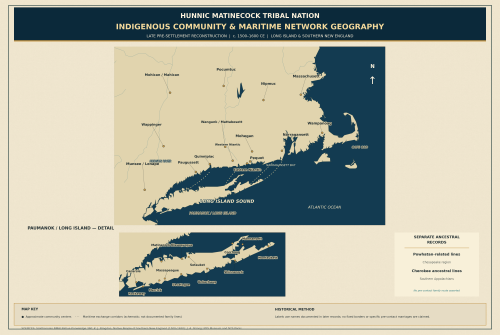
The Ancestral Kinship and Sachemic Networks of the Eastern Woodlands
The Hunnic Matinecock Tribal Nation preserves the history of its ancestral families within a wider Indigenous world that existed long before colonial borders divided the lands now called New York, Connecticut, Rhode Island, Massachusetts, and the surrounding regions.
These networks were sustained through hereditary relationships, intermarriage, sachemic diplomacy, reciprocal obligations, shared waterways, and intercommunity exchange.
The Nation’s historical record connects Sachem Catoneras and her succeeding generations with the western Long Island sachemic network, while additional historical sources document relationships among the Montaukett, Pequot, Mohegan, Niantic, Narragansett, and neighboring peoples.
The accompanying map distinguishes documented family relationships, historical diplomatic agreements, and broader regional networks. It also identifies the Nation’s separately preserved Powhatan and Cherokee ancestral records.
The purpose of this map is to preserve the reach of ancestral relationships across generations and provide a foundation for historical understanding, continuing stewardship, and the renewal of ancestral bonds.
Map note: Geographic placements are indicative historical centers, not surveyed territorial boundaries. Different relationships are identified according to their respective historical and genealogical evidence.
II. Northeastern Indigenous Lines
The Nation’s ancestral record extends through Indigenous peoples of Long Island, Southern New England, the Hudson Valley, and the wider Northeastern Woodlands.
These relationships reflect centuries of movement, marriage, alliance, diplomacy, shared territory, reciprocal protection, and confederated governance.
Matinecock, Montaukett, Massapequa, Shinnecock, and Unkechaug Relationships
The Nation’s principal Long Island continuity is situated within the related political and kinship world of the:
- Matinecock
- Montaukett
- Massapequa
- Shinnecock
- Unkechaug
- Related Long Island Indigenous peoples
These communities maintained distinct identities while also participating in wider systems of kinship, diplomacy, trade, land stewardship, and sachemic relationship.
The Nation’s ancestral lines are preserved according to the evidence applicable to each family and relationship.
Pequot and Narragansett Relationships
The Nation preserves ancestral and collateral relationships within the Pequot and Narragansett worlds.
These include lines associated with:
- Quashawan
- Sachem Sassacus
- Sachem Tatobem
- Grand Sachem Canonicus
- Related Pequot and Narragansett families
Quashawan is preserved within the Nation’s record as an ancestral matriarch associated with Pequot and Narragansett kinship.
Family traditions and genealogical research place her within a sachemic network connected to Sassacus and related families. Where her precise parentage remains under continued archival study, the Nation classifies the relationship accordingly rather than presenting tradition as conclusive documentary proof.
Canonicus is preserved within a separate Narragansett ancestral line. His historical standing as a principal sachem and diplomat provides context for the political and intertribal world represented within that ancestry.
These relationships are part of the Nation’s own ancestral record. They do not confer authority over the citizenship, government, lands, or internal affairs of contemporary Pequot or Narragansett nations.
Mohegan Relationships
The Nation also preserves ancestral and collateral relationships within the Mohegan sphere.
These include lines associated with:
- Uncas
- We-ta-quash
- Mary Uncas
- Related Mohegan families
The significance of these relationships arises through ancestry, kinship, marriage, regional diplomacy, and the interconnected political world of Southern New England.
The continuing government and historical record of the Mohegan people provide important corroborative context for that world without serving as the source of the Hunnic Matinecock Tribal Nation’s authority.
Mattabesett and Wangunk Relationships
The Nation’s record includes relationships associated with:
- Sequin
- Sowheag, also known as Sequasson
- Mattabesett and Wangunk families
- Connecticut River Indigenous communities
These lines connect the Nation to the inland and coastal Indigenous networks of Southern New England.
Their importance rests in sachemic relationship, family continuity, regional alliance, and the preservation of Indigenous peoplehood through periods of displacement and colonial disruption.
Wappinger, Munsee–Lenape, and Hudson Valley Continuity
The Nation maintains historical and kinship relationships within the Wappinger, Munsee–Lenape, Ramapo, and wider Hudson Valley Indigenous sphere.
The Hudson Valley and Long Island formed parts of an interconnected Northeastern world long before the creation of present counties and state boundaries.
Indigenous families moved, intermarried, traded, entered alliances, and maintained relationships across these regions.
The Nation’s present seat in Rockland County is located within this ancient Indigenous landscape.
The Nation therefore understands its Long Island foundation and Hudson Valley presence as related parts of a wider Northeastern continuum.
The Ancient Northeastern Kinship and Diplomatic Continuum
Long before the establishment of colonial governments or the political borders now separating New York, Connecticut, Rhode Island, and Massachusetts, the Indigenous peoples of Long Island and southern New England maintained extensive networks of kinship, intermarriage, diplomacy, commerce, and reciprocal responsibility.
The historical record identifies relationships extending from the Matinecock, Massapeague, Montaukett, and neighboring Long Island communities across Long Island Sound to the Pequot, Mohegan, Niantic, Narragansett, and other Indigenous peoples.
These relationships existed before sustained colonial settlement and developed through succeeding generations.
Historical documentation includes the 1655 diplomatic delegation acting on behalf of Sachem Tackapousha, which recorded inherited peace obligations involving the Narragansett and coordination with Sachem Wyandanch.
Additional records preserve marriages, shared territorial interests, and diplomatic relationships between Indigenous leadership families.
The eighteenth-century relationships among the Montaukett, Mohegan, Pequot, Niantic, Narragansett, Tunxis, and Oneida further demonstrate how Indigenous peoples maintained and renewed intercommunity connections during periods of displacement and political transformation.
The Hunnic Matinecock Tribal Nation preserves this wider historical continuum alongside its documented ancestral line through Sachem Catoneras and succeeding generations.
Within the Nation’s customary-law understanding, ancestral kinship and inherited responsibilities are not defined solely by later colonial territorial classifications.
The Nation recognizes the historical importance of these relationships, the distinct identities of the peoples who participated in them, and the responsibility to preserve their documented history for future generations.
The ancestral world of our people extended beyond a single village, sachemship, island, or colonial boundary. Its relationships formed part of a wider Indigenous history that remains worthy of preservation, understanding, and renewal.
Métis and Ojibwe Collateral Kinship
The Nation preserves an extended Métis and Ojibwe kinship relationship through the Visner/Vézina family network.
Joseph Paul Vézina, also recorded as Joe Visner (1859–1945), belongs to a collateral family branch connected to the Nation through the David–Montross descendant network. Genealogical reconstruction identifies him within the Grand Chief’s extended cousin relationship rather than as a direct parent-child ancestor.
Visner’s family history carries documented Métis and Ojibwe ancestry, placing this collateral branch within the interconnected Indigenous and Métis kinship world of Canada and the Great Lakes.
The Nation therefore records this relationship as:
- Extended collateral Indigenous kinship
- Métis family relationship
- Ojibwe-connected kinship
- Canadian Indigenous family continuity
- A relationship carried through the wider David–Montross family network
The Nation does not present this relationship as direct Ojibwe descent where the genealogical chain establishes collateral cousin kinship.
Under Indigenous principles of extended family and relational continuity, collateral kin remain part of the wider family network while retaining the distinct identity, citizenship, and governmental relationships of the peoples from whom they descend.
This relationship expands the Nation’s documented kinship geography beyond Long Island, the Hudson Valley, and Southern New England into the Great Lakes and Canadian Indigenous world.
III. Haudenosaunee-Connected Continuity
The Nation preserves Haudenosaunee-connected relationships through ancestry, kinship, adoption, alliance, marriage, and confederated history.
These relationships include Kanien’kehá:ka, or Mohawk-connected, ancestral and collateral lines.
The Nation evaluates these relationships through:
- Documentary genealogy
- Family history
- Indigenous kinship traditions
- Adoption and incorporation
- Marriage alliance
- Regional diplomacy
- Continued archival research
The Treaty of Canandaigua of 1794 forms part of the continuing treaty history of the Six Nations.
Within this record, it provides legal and historical context for Haudenosaunee peoplehood and treaty-bearing status.
It is not presented as proof that a single ancestral or marital relationship automatically transfers every treaty right, citizenship status, or governmental power to all descendants.
The Nation’s Haudenosaunee-connected ancestry remains significant in its own right.
The continuing status of Haudenosaunee nations and their treaties adds corroborative weight to the political and diplomatic history surrounding those lines.
IV. Cherokee and Southeastern Continuity
The Nation maintains documented Cherokee ancestry through the Davis, Price, and Smith family lines.
The record includes Dawes-era documentation associated with:
- Jeremiah L. Davis
- Joseph Price
- Annie C. Smith
- Related Davis, Price, and Smith descendants
These records provide a significant documentary foundation for the Nation’s Southeastern Indigenous ancestry and historical community relationship.
The Nation also preserves Powhatan, Shawnee, and related Southeastern ancestry through distinct family lines and marriage relationships.
These lines are evaluated independently according to their own genealogical and historical evidence.
The Cherokee treaties of Hopewell, Holston, and New Echota form part of the historical and legal treaty framework of the Cherokee people.
Within the Nation’s record, those treaties provide context for the political and treaty-bearing nation represented within its documented Cherokee ancestry.
The Nation distinguishes among:
- Cherokee ancestry;
- Dawes-era documentation;
- historical community connection;
- present-day citizenship in a Cherokee nation;
- application of a particular treaty provision; and
- the independent authority of the Hunnic Matinecock Tribal Nation.
The existence of one does not automatically establish all others.
Each is stated according to its own evidence and governing law.
V. Colonial-Era Descendant Families
The descendants of Sachem Catoneras and Cornelius Jansen Van Texel continued through families established across Long Island, New York, Connecticut, the Hudson Valley, and neighboring regions.
These families include:
- Van Texel and Van Tassel
- Knapp
- Travis and Travers
- Lent
- Outhouse
- Dyckman and Dykman
- Related descendant families
Their relevance to this record does not arise primarily from colonial rank or social standing.
Their significance lies in the transmission of:
- Catoneras’s maternal line;
- Indigenous ancestry;
- inherited family relationships;
- land and community memory;
- descendant continuity; and
- historical responsibility.
Indigenous ancestry was frequently carried through families later recorded under European surnames.
Intermarriage, migration, religious conversion, census classification, and participation in colonial communities did not automatically terminate Native descent or kinship.
A change in surname did not end maternal inheritance.
Movement from a homeland did not erase family relationship.
The Nation includes these families where the genealogical and documentary record supports their place within the ancestral line.
VI. Treaty and Compact Framework
The Nation’s ancestral history intersects with treaties, petitions, deeds, compacts, and diplomatic instruments involving the Indigenous peoples represented within its lines.
These include:
- The Catoneras–Van Texel Kinship Compact
- The Crab Meadow records
- The circa – 1685 petition of Jan Cornelissen Van Texel and the 1705 petition of his Van Texel heirs.
- Long Island Indigenous deeds and land records
- The Treaty of Hartford and related regional instruments
- Narragansett and Mohegan diplomatic agreements
- Mattabesett and Wangunk agreements
- The Treaty of Canandaigua of 1794
- The Cherokee Treaty of Hopewell of 1785
- The Cherokee Treaty of Holston of 1791
- The Treaty of New Echota of 1835
- Related Indigenous–Crown and Indigenous–United States instruments
These records demonstrate that the ancestral peoples represented within the Nation’s lines acted as political communities possessing their own:
- Leaders
- Laws
- Territories
- Diplomatic authority
- Landholding systems
- Kinship rules
- Capacity to enter agreements
The treaties and compacts add legal and historical weight to the political world represented within the Nation’s ancestry.
They do not serve as a substitute for the Nation’s own government, people, customary law, or continuity.
The application of any particular treaty provision must be considered according to:
- The text of the instrument
- The original parties
- The relevant Indigenous laws
- The nature of the ancestral or political relationship
- Continuing governmental interpretation
- Applicable present law
VII. Classification of Ancestral Relationships
The Nation classifies relationships within this record to preserve accuracy and institutional clarity.
Documented Direct Ancestor
A person from whom descent is established through a successive parent-child line supported by genealogical or historical records.
Collateral Ancestor or Kin
A person connected through a sibling branch, extended family line, shared ancestor, or documented kinship relationship.
Sachemic Relationship
A direct, collateral, marital, protective, successor, or political relationship involving an Indigenous sachemic family or office.
Traditional Lineage
A relationship preserved through family, community, or tribal tradition that is not yet conclusively demonstrated through the surviving documentary record.
Treaty-Connected Ancestry
Descent or kinship associated with an Indigenous people that entered a treaty, petition, compact, deed, or diplomatic agreement.
Adoptive or Confederated Relationship
A relationship created or preserved through Indigenous adoption, incorporation, alliance, shared governance, protection, or confederated law.
Corroborative Historical Relationship
A record, treaty, roll, recognized government, or archive that adds context and evidentiary weight without serving as the original source of the Nation’s authority.
These classifications allow the Nation to preserve its inherited record without collapsing distinct forms of relationship into a single category.
VIII. Evidentiary Foundation
The Nation maintains its Treaty Descent Record through the cumulative study of:
- Indigenous law and custom
- Family records
- Oral and inherited traditions
- Vital records
- Census records
- Church and burial records
- Deeds and land instruments
- Petitions
- Colonial records
- Court records
- Federal and state archives
- Tribal and community histories
- Dawes-era records
- Documentary genealogy
- Genetic evidence used as supporting context
- Continuing archival research
- Living governance and institutional continuity
No single record defines the Nation.
Documentary genealogy establishes family relationships where the evidence permits.
Historical records establish identity, land relationship, political activity, and context.
Indigenous law establishes the meaning of kinship, succession, marriage, adoption, compact, alliance, and inherited responsibility.
Genetic evidence may assist in corroborating biological relationships or broader ancestry. It does not independently establish tribal citizenship, sachemic office, treaty entitlement, or governmental authority.
The Nation’s record is cumulative.
Its strength lies in the relationship among the evidence, not in dependence upon one document, one ancestor, one treaty, one database, or one outside classification.
IX. National Record of Continuity
The Hunnic Matinecock Tribal Nation records the following findings:
- Sachem Catoneras is a documented foundational maternal ancestor identified in the historical record as an “Indian native Sachem.”
- Her Indigenous interests were inherited through Native family relationship and were not created by colonial grant.
- Her son, Jan Cornelissen, derived his claim through Catoneras and her Indigenous relations.
- The Crab Meadow record places Catoneras and her descendants within the wider landholding and sachemic network associated with Tackapousha and Opsam.
- The Catoneras–Van Texel union carried Indigenous ancestry, maternal inheritance, kinship, and successor responsibility into later generations.
- The Nation maintains additional direct, collateral, traditional, adoptive, confederated, and treaty-connected relationships among Indigenous peoples of Long Island, Southern New England, the Hudson Valley, the Haudenosaunee sphere, and the Southeast.
- The political and treaty histories of related Indigenous nations provide corroborative context for the ancestral world represented within the Nation’s lines.
- The authority of other Indigenous nations over their citizenship, territory, treaties, and internal affairs remains distinct and respected.
- The Nation’s own continuity is expressed through ancestry, Indigenous law, organized government, preservation of records, cultural stewardship, diplomacy, national institutions, and service to present and future generations.
Official Declaration
The Treaty Descent Record is maintained as an official national record of the Hunnic Matinecock Tribal Nation.
It preserves the ancestry, kinship, sachemic relationships, treaty-connected histories, and inherited responsibilities carried into the present generation.
The Nation does not borrow its existence from another government.
It does not rely upon the recognition status of another Indigenous nation as the source of its authority.
It honors related nations, treaties, rolls, archives, and continuing governments as important parts of the historical and political world reflected within its ancestry.
Its foundation remains its own:
- People
- Descent
- Kinship
- Indigenous law
- Inherited responsibility
- Government
- Institutions
- National service
The Nation preserves what was inherited.
It governs in the present.
It carries the responsibility forward.