
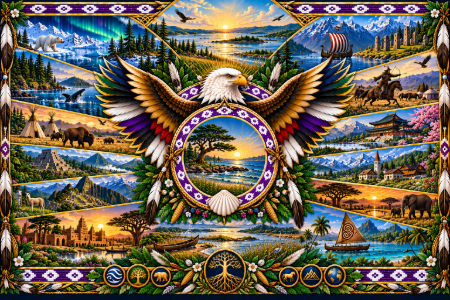
National Flag of the Hunnic Matinecock Tribal Nation
A symbol of our living government, ancestral inheritance, Indigenous identity, and enduring responsibility to our people, our homelands, and future generations.
By Blood. By Law. By Sacred Mandate.
Ancient Blood. Enduring Law. Living Sovereignty.
Indigenous Government • Ancestral Continuity • Global Stewardship
Skennen’kó. Welcome to the official website of the Hunnic Matinecock Tribal Nation.
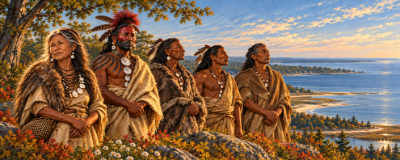
Female sachem Catoneras; Montaukett sachem Wyandanch; Massapequa sachem Tackapousha; his son Opsam; and Wenox. The 1685 Crab Meadow deed records Opsam and Wenox as joint landholders alongside Catoneras’s son, Jan Cornelissen, with Tackapousha among the witnesses—preserving evidence of Long Island’s interconnected Indigenous landholding and leadership networks.
Artistic reconstructions informed by historical research and available portrait references.
The Hunnic Matinecock Tribal Nation is a living Indigenous government carrying forward inherited sachemic responsibility, ancestral kinship, customary law, historic compacts, treaty relationships, and active national service.
Rooted in the interconnected Indigenous homelands of Long Island, the Hudson Valley, Southern New England, and the wider Northeastern Woodlands, the Nation preserves its inheritance, governs in the present, and builds for generations yet to come.
Our sovereignty is ancestral.
Our government is living.
Our responsibilities continue.
Explore the Nation
Government and Leadership
Programs and Initiatives
National News
A Living Indigenous Nation
The Hunnic Matinecock Tribal Nation exists through continuity of people, kinship, law, governance, compact, and inherited responsibility.
Our authority did not begin with a colonial record, administrative designation, or outside government. It arises from Indigenous peoples, families, sachemic networks, and legal traditions that existed before the formation of New York and the United States.
The Nation carries this continuity through:
- Lineal and collateral descent
- Maternal and paternal inheritance
- Sachemic and hereditary succession
- Marriage, adoption, and family alliance
- Confederated Indigenous relationships
- Ancestral compacts and treaty obligations
- Continuing government and national service
We do not preserve our history merely to remember who we were.
We govern because that history remains alive.
Learn About Our Continuity
Our Homeland
The Nation is ancestrally rooted in the Indigenous world of Long Island, the Hudson Valley, Southern New England, and the broader Northeast.
These homelands were shaped by interconnected peoples, including the Matinecock, Montaukett, Massapequa, Shinnecock, Unkechaug, Wappinger, Munsee–Lenape, Ramapo, Pequot, Narragansett, Mohegan, Mattabesett, Wangunk, and related Indigenous nations and communities.
Their relationships crossed the boundaries later imposed by counties, colonies, states, and federal governments. They were connected through kinship, marriage, diplomacy, shared waterways, trade, stewardship, protection, sachemic leadership, and confederated governance.
The Nation’s government is presently seated in Rockland County, within an ancient Indigenous homeland that long predates the county, the state, and the United States.
Our presence here is not outside the Indigenous world. It reflects the continuing movement, survival, kinship, and governance of Native peoples across ancestral lands altered—but never erased—by colonization and displacement.
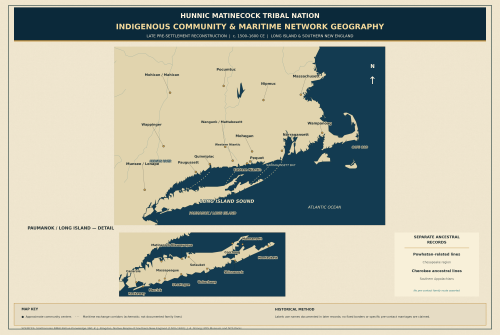
Our Ancestral Homelands — Before Colonial Borders
A historical reconstruction of the Indigenous communities and regional networks of Long Island, the Hudson Valley, and Southern New England, circa 1500–1600 CE.
These interconnected ancestral homelands existed long before the establishment of modern states and colonial boundaries.
Explore the full ancestral map, historical kinship networks, and supporting records in our Treaty Descent Record.
Explore Our Homeland
Sachem Catoneras
A Foundational Mother of the Nation
Sachem Catoneras stands as one of the principal ancestral and governmental foundations of the Hunnic Matinecock Tribal Nation.
Surviving historical records expressly identify her as an “Indian native Sachem.”
Records associated with approximately 1685, 1705, and 1713 further establish that Catoneras possessed inherited Indigenous interests connected to Crab Meadow and that those interests continued through her Native family relationships.
Her son, Jan Cornelissen, derived his inheritance through his mother, Catoneras, and through her Indigenous relations—not from an original colonial grant.
The surviving records therefore corroborate an Indigenous inheritance that already existed under Native law and kinship tradition.
Through her union with Cornelius Jansen Van Texel, also recorded as Van Tassel, Catoneras carried Indigenous kinship, maternal inheritance, family authority, and successor responsibility into succeeding generations.
The Nation affirms the uninterrupted continuity of Catoneras’s ancestral bloodline and recognizes the transmission of her hereditary responsibilities through succeeding generations in accordance with its Indigenous customary law.
The Nation recognizes this enduring relationship as the:
Catoneras–Van Texel Kinship Compact
The Compact represents continuity through Indigenous marriage law, maternal inheritance, family alliance, land relationship, intercultural diplomacy, and continuing descendant responsibility.
Catoneras and her descendants also appear within the wider Indigenous landholding and sachemic network connected to Tackapousha, principal sachem of the Massapequa, and Opsam, identified in the historical record as his son.
This places Catoneras within a documented Indigenous political and governmental order extending across western Long Island.
Sachem Catoneras is not remembered merely as a distant ancestor.
She is recognized as a documented female sachem whose inherited standing forms an essential part of the Nation’s living foundation.
Learn About Sachem Catoneras
Explore the Catoneras–Van Texel Kinship Compact
Generations of Ancestral Continuity
The ancestral inheritance of the Hunnic Matinecock Tribal Nation reaches through generations of Indigenous leadership, maternal and paternal descent, kinship, and continuing hereditary responsibility.
Among the foundational figures preserved in the Nation’s ancestral record stands Sachem Catoneras, whose Indigenous standing and inherited interests are expressly identified in surviving historical petitions.
Her son, Jan Cornelissen Van Texel, asserted his inheritance through his Indigenous mother and her kindred. In succeeding generations, his children, including Catharine Van Texel Lent, Cornelis, Jacob, Jan, Willem, Sara DeWitt, and Margaret Storm, continued that hereditary claim in petitions recorded in 1705 and 1713.
The Nation also preserves the wider historical relationships connecting the Matinecock, Massapeague, Montaukett, and neighboring Indigenous peoples through such leaders as Asharoken, Suscaneman, Tackapousha, Wyandanch, and Sunksqua Quashawam.
These ancestral families and historical leadership networks demonstrate the enduring importance of Indigenous descent, recognized kinship, inherited responsibilities, and customary governance.
The Nation affirms the continuity of its own hereditary ancestral lines under Indigenous customary law. The surviving colonial records are preserved as corroborating testimony of earlier Indigenous inheritance and authority, not as the originating source of that inheritance.
Our ancestral record spans generations. Our responsibility to carry it forward remains living and enduring.
Indigenous Law Comes First
The Hunnic Matinecock Tribal Nation understands its identity, inheritance, and authority first through Indigenous law.
A colonial record may document an Indigenous relationship.
It does not create that relationship.
A deed may record an exchange.
It does not originate the Indigenous authority required to enter it.
A government document may identify a sachem.
It does not create the sachem’s office.
A treaty may acknowledge a nation.
It does not create the nation.
A court may recognize an obligation.
It does not originate Indigenous sovereignty.
The Nation therefore interprets its continuity through Indigenous principles of kinship, succession, customary governance, family authority, alliance, stewardship, reciprocity, diplomacy, and collective memory.
Colonial, state, and federal records may corroborate our history. They do not define the full boundaries of Indigenous existence.
Explore Indigenous Law and Continuity
From First Humanity to Living Nationhood
The Nation understands human history as a long continuity of migration, peoplehood, land, law, and responsibility.
Humanity’s earliest known origins are in Africa. From that first homeland, ancient peoples moved across the world, formed nations, developed languages, established systems of law, and entered enduring relationships with the lands that sustained them.
The ancestors of the Indigenous peoples of the Americas emerged through ancient migrations and developed distinct nations throughout these continents over thousands of years.
Ancient migration does not diminish indigeneity.
Indigeneity is expressed through enduring peoplehood, kinship, law, governance, culture, memory, stewardship, and relationship to homeland long before later conquest or colonial administration.
The Sovereign Head of the Hunnic Matinecock Tribal Nation carries multiple lines of ancient continuity extending through Africa, Asia, the Steppe, Europe, and the Indigenous peoples of North America.
These inheritances do not compete with one another.
They converge within one living responsibility.
Our wider ancestry informs our worldview.
Our documented Indigenous lines establish our Native continuity.
Our government demonstrates that the responsibility remains alive.
Many Ancient Lines. One Living Responsibility.
Government and Leadership
The Hunnic Matinecock Tribal Nation exercises its authority through organized government, defined offices, national institutions, and continuing public service.
Office of the Grand Chief
The Grand Chief and Grand Sachem serve as Sovereign Head and principal executive and diplomatic representative of the Nation.
The Office carries responsibility for national governance, preservation of sachemic continuity, Indigenous and hereditary affairs, treaty and close relationships, intergovernmental relations, international diplomacy, national development, cultural stewardship, and protection of future generations.
Office of the First Lady
The Office of the First Lady advances the Nation’s social, cultural, educational, humanitarian, family, safeguarding, and public-service responsibilities.
Its work includes children and families, women and girls, education, cultural dignity, responsible storytelling, humanitarian cooperation, and community well-being.
National Institutions
The Nation carries out its responsibilities through governmental, cultural, educational, humanitarian, environmental, economic, media, sporting, diplomatic, and research institutions.
Each institution operates within its defined mandate while remaining accountable to the Nation’s governing authority.
Meet the Leadership
Explore National Offices
Sovereignty in Service
Sovereignty is not only inherited.
It must be exercised responsibly.
The Nation advances programs and institutions in:
Culture and History
Preserving ancestral knowledge, records, family lines, oral traditions, cultural relationships, and the memory of those who carried the Nation forward.
Education and Youth
Creating pathways through cultural education, mentorship, leadership development, safeguarding, international learning, media, and sport.
Health and Humanitarian Affairs
Supporting culturally responsible healthcare, medical access, clean water, food security, community wellness, and humanitarian cooperation.
Environmental Stewardship
Protecting watersheds, lands, ecosystems, food systems, and Indigenous environmental knowledge as a continuing governmental responsibility.
Responsible Technology
Advancing ethical technology, human oversight, Indigenous data sovereignty, free, prior, and informed consent, and protection against unauthorized use of Indigenous knowledge.
Media and Public Information
Supporting independent Indigenous storytelling, responsible journalism, public education, and stronger platforms for communities whose voices have been overlooked.
Sport and Global Opportunity
Using sport to advance youth development, wellness, cultural pride, diplomacy, economic opportunity, and international cooperation.
Explore Programs and Initiatives
Intergovernmental and International Relations
The Hunnic Matinecock Tribal Nation maintains relationships with Indigenous nations, governments, universities, humanitarian organizations, cultural institutions, international leaders, and responsible enterprises.
The Nation enters its alliances from a position of sovereign equality.
We work alongside our partners.
We do not enter relationships of institutional subordination.
Our relations are founded upon:
- Mutual respect
- Reciprocity
- Non-subordination
- Free, prior, and informed consent
- Indigenous data sovereignty
- Cultural integrity
- Respect for jurisdiction
- Transparent responsibilities
- Shared benefit
- Continuing accountability
We respect the distinct sovereignty, citizenship laws, territories, governments, traditions, and political authority of other Indigenous nations.
Our own continuity is established through our documented ancestry, living families, inherited kinship, sachemic relationships, historical record, customary law, national institutions, continuing governance, and present service.
Our door remains open to respectful dialogue, kinship renewal, shared initiatives, and principled nation-to-nation cooperation.
Indigenous Relations
International Relations
Alliances and Partners
National News and Official Statements
Stay informed about the government and work of the Hunnic Matinecock Tribal Nation.
Read official updates concerning:
- Statements from the Grand Chief
- Government announcements
- Alliances and agreements
- National programs
- Cultural and historical developments
- Humanitarian initiatives
- Environmental projects
- Educational opportunities
- International engagements
- National observances
- Press and media
View National News
Official Statements
Press and Media
Declaration of National Continuity
The Hunnic Matinecock Tribal Nation exists through continuity of people, kinship, law, governance, compact, and inherited responsibility.
Our authority does not arise from the permission of an outside institution.
Our sovereignty is not created by an administrative designation.
Our history is not reduced to a single colonial record.
Our Nation has not been invented, and it has not been revived. It has continued.
We honor those who preserved our bloodlines.
We honor those who carried our identities through displacement, intermarriage, migration, and reclassification.
We honor the sachems, matriarchs, families, protectors, and descendants through whom responsibility survived.
We accept the duty to carry that inheritance openly, lawfully, and with discipline.
We govern for those living today.
We preserve for those yet to come.
Ancient Blood. Enduring Law. Living Sovereignty.
Walk With the Nation
The Hunnic Matinecock Tribal Nation welcomes respectful engagement with Indigenous nations, governments, hereditary authorities, universities, cultural institutions, humanitarian organizations, environmental stewards, responsible enterprises, and communities of goodwill.
Those who walk with us do so through mutual dignity, sovereign respect, and shared purpose.
Together, we can preserve culture, protect the natural world, strengthen families, educate future generations, expand healthcare, create opportunity, advance Indigenous media, develop responsible technology, and renew the ancient practice of diplomacy among peoples.
Contact the Nation
Government Liaison
Partnership Inquiries
Media and Press
Hunnic Matinecock Tribal Nation
Indigenous Government • Ancestral Continuity • Global Stewardship
Ancient Blood. Enduring Law. Living Sovereignty.
Sovereign Notice
Nothing published on this website shall be interpreted as a waiver, limitation, delegation, surrender, or abandonment of the sovereignty, jurisdiction, immunity, customary authority, treaty position, cultural rights, intellectual property, or legal interests of the Hunnic Matinecock Tribal Nation.
All rights, authorities, protections, remedies, and positions are expressly reserved.
Official Use Notice
The Nation’s name, governmental titles, seals, insignia, cultural materials, archival records, and intellectual property may not be reproduced, modified, or used in any manner implying endorsement, authority, affiliation, or partnership without prior written authorization.
© Hunnic Matinecock Tribal Nation. All Rights Reserved.